
95% of retail companies have only one location.

95% of retail companies have only one location.
 I was doing some reading today and ran across these findings from PWC from 2015 and thought I would share an excerpt and the link.
“According to the survey, only 27 percent of U.S. consumers say they shop online weekly. Reserving the strength of the traditional store, 68 percent of U.S. respondents say they have intentionally browsed products at a store but decided to purchase them online, while 73 percent say they have browsed products online but decided to purchase them in-store. Sixty-five percent of the respondents noted delivery fees as the reason for purchasing in-store, as well as having the item immediately (61 percent), and trying it on/seeing it (61 percent).”
from Physical Store Beats Online as Preferred Purchase Destination for U.S. Shoppers, According to PwC
The last line is critical. Immediacy and the tactile experience are the key advantages of brick & mortar.

Many people assemble a “Summer Reading List.” Sometimes these are actual plans that are carried out and other times they are mere wish lists of books that aspire to read. The types of books that make the list can range from the easy to read and not too taxing books of romance, mysteries and the like. Others tackle the classics, those books that you should have read years ago but never got around to. (I recently picked up Three Famous Short Novels by William Faulkner and quickly realized why I never got through them in college.)
So, if you are in retail and are looking for a good read, I recommend Selling Retail Books 1 & 2 by John F. Lawhon. This classic was first published over 30 years ago and continues to stay relevant and insightful today.

From saving arms to increasing transaction size to marring car finishes, a new era of shopping convenience begins on June 4th,1937 with the introduction of the shopping cart.
On April 3rd, 1920, Sylvan Goldman and his brother Alfred, opened the first supermarket in the state of Oklahoma. One evening in 1936, Sylvan began to wonder how he might get people to buy more items in his store. He realized that many shoppers limited their purchases to what they could hold easily in the arms or carry in a small basket. Looking aroundHe found a folding chair that he fastened two baskets to the seat and attached wheels to the legs. He knew he was on to something.
Over the next few months, he worked with Fred Young and Arthur Kosted, area mechanics, to refine his invention. Finally, on June 4th, 1937, he introduced the shopping cart at his Humpty-Dumpty Supermarket in Oklahoma City.
Along with a lucrative retail career, Sylvan also invented the airport baggage cart.
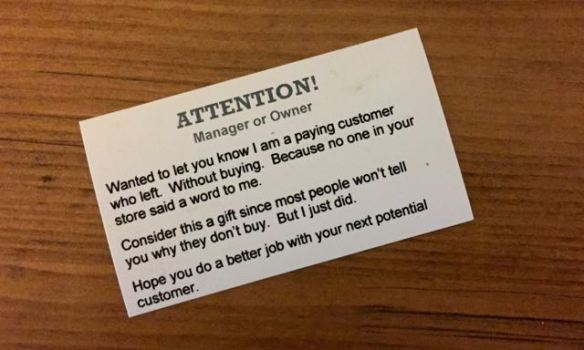 I have followed Bob Phibbs, the The Retail Doctor for several years and I am a big fan of his work. He once wrote about a card that he carried with him when he was out and if he ever visited a store and was ignored, he would leave the card when he exited the store.
When I read that post, I thought that is something that I should do. So I produced a stack of the card that you see above and have carried them in my wallet ever since. The other day, I dropped a card off in a local shop.
I just wish they knew that it was also a gift from Bob.

Retailers would have you believe that Memorial Day Sales cannot be missed. The advertisements make it sound like the stores are giving things away for next to nothing. Caught up in the fervor, my wife and I headed out on Monday to catch the end of some of the sales.
As we wandered through one of the stores something caught my wife’s eye. Uninterested, I continued to wander through the store when a customer interaction caught my eye. So I moved in for a closer look. Something just didn’t seem right.
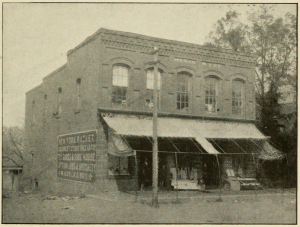
May 29th 1888, William Belk opens The New York Racket in Monroe, NC. The store later became known as the Belk Department Store.
One of the innovations that William Belk brought to retailing was the concept of buying in bulk and passing the savings on to the customer.
They have come a long way.

I found this in my shopping bag the other day after a quick grocery run. I applaud the effort of Safeway and George.
Would your employees feel comfortable doing the same?
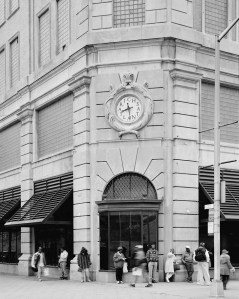
On May 28th, 1867, Mauritius Reich, a Hungarian immigrant, opened a dry goods store at 36 Whitehall St in Atlanta, Georgia. The store named M. Rich Dry Goods with the name being derived from Mauritius Reich’s name being anglicized to Morris Rich.
Due to their rapid success, Rich’s moved four times by 1882 and was considered one of the big five retailers in Atlanta. The Rich family operated the company until 1976 and the name plate was retired by the current owners on March 6th, 2005.
Rich’s enjoyed a loyal following over it 100+ years in operation. Two fondly remembered traditions are the Great Tree for Christmas and the Pink Pig monorail in the toy department for the Holidays.

A PDX Classic
An old school store providing old school service since 1919.
 The Observant Customer