

It was bad enough that two employees were talking on the sales floor while people all around them went unserved, but it was their discussion was what put it over the top.
(I share the story only to illustrate the types of discussions that should not be held on the sales floor.)
The first employee was asking the second one how they had been. The first employee then went on to describe that flu that she had suffered through. She said that several times when she ran to the bathroom she could not decide whether she should bend over or sit down as “it was coming out of both ends!” I expected the other employee to be a bit put off by such a topic on the sales floor within ear shot of customers. Continue reading

 He was timid, reserved and soft-spoken. We have all run across this type of customer before. It’s challenging to get them to warm up to you, they can be slow to offer information and they can even be hard to hear.
 This is the first in a four-part series on dealing with experts in your retail store from several different perspectives. For the sake of these posts, when I refer to an expert I am referring to someone who has advantaged knowledge or experience about the products being sold and their usage. Today’s perspective is dealing with a customer that is an expert.

 Making a return is not something that most people look forward to at a retail store. Making a return means that you failed at your earlier attempt to successfully buy something. Maybe it didn’t meet your needs, it was the wrong size or color, it did not fit or you just didn’t like it. Making the return is usually inconvenient and certainly takes time and effort. So, why do stores make it worse than it has to be?
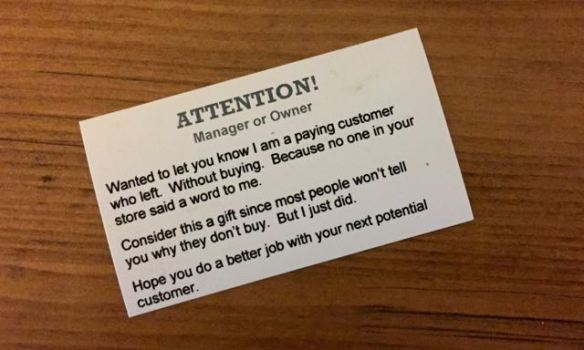 I have followed Bob Phibbs, the
  I stopped by a local shop the other day. I was in a hurry and just needed to pick up one thing. Grabbing the item, I headed to the registers.
 The Observant Customer